
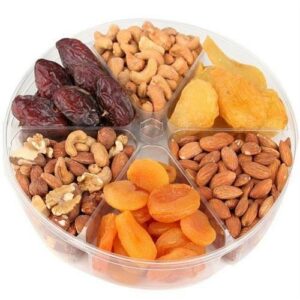
High cholesterol is when you have too much of a fatty substance called cholesterol in your blood. The NHS says it does not usually cause symptoms, and you can only find out if you have it from a blood test. Among its causes the NHS lists eating fatty food, not exercising enough, being overweight, smoking and drinking alcohol, and it says you can lower your cholesterol by eating healthily and getting more exercise. Food is the part you control every day, so this post starts there and then looks at where dates fit.
The foods the NHS says to eat more of
The NHS page on how to lower your cholesterol starts with fat. Its advice is to cut down on fatty food, especially food high in saturated fat, while still eating foods with unsaturated fat. It suggests eating more of these:
- oily fish, like mackerel and salmon
- olive oil, rapeseed oil and spreads made from these oils
- brown rice, wholegrain bread and wholewheat pasta
- nuts and seeds
- fruits and vegetables
On the same page, the foods to eat less of are meat pies, sausages and fatty meat, butter, lard and ghee, cream and cheese, cakes and biscuits, and food that contains coconut oil or palm oil. Ghee, coconut oil and palm oil are on it, so the list covers cooking fats as well as snacks. The NHS also suggests checking food labels to see what type of fat a product has in it.
Where dates fit
Dates are a fruit, so they sit on the "eat more" side of that list. The USDA FoodData Central record for Deglet Noor dates shows 0 mg of cholesterol, 0.39 g of total fat and 0.032 g of saturated fat per 100 g, with 8.0 g of fibre. Medjool dates have 0.15 g of total fat and 6.7 g of fibre per 100 g. In other words, dates add almost no fat to a meal.
Containing no cholesterol is not the same as lowering it, though. For that, you need studies where people actually ate dates and had their blood tested.
What the date studies found
In a small pilot study (Rock et al., 2009), ten healthy adults ate 100 g a day of Medjool or Hallawi dates for four weeks. Their total cholesterol did not change significantly, and neither did the cholesterol carried in their LDL, HDL or VLDL. Their triglycerides, another blood fat, fell by 8% after Medjool and 15% after Hallawi dates.
A randomised trial by researchers in Bahrain (Butler et al., 2022) gave 79 adults with type 2 diabetes either 60 g of dates or 60 g of raisins a day for 12 weeks, and 61 of them completed it. There was no difference between or within the groups for blood lipids.
A 2025 meta-analysis (Mirghani and Alhowiti, 2025) pooled 14 cohorts from four randomised studies, with 298 participants who had type 2 diabetes. Dates reduced total cholesterol in the pooled result, but there was no significant change in LDL cholesterol, triglycerides or HDL cholesterol. The results varied a lot between studies (heterogeneity of 90% for total cholesterol), and the authors say larger studies are needed.
Put together, the evidence is mixed and small. In the only study of healthy people here, dates did not lower cholesterol. What the studies do suggest is that eating dates did not make blood lipids worse.
Swap, don't add
Being overweight is one of the NHS causes of high cholesterol, and dates are energy-dense: 277 kcal per 100 g for Medjool and 282 kcal for Deglet Noor in FoodData Central. The useful move is to use dates in place of something on the "eat less" list, such as cakes and biscuits, rather than eating them on top of everything else. The NHS counts a 30 g portion of dried fruit, such as dates, as one of your 5 A Day, and says it should be eaten at mealtimes rather than as a snack between meals, to reduce the risk of tooth decay.
If you buy in bulk from a kurma supplier in Malaysia, check the current harga kurma before restocking, and read the label on coated or stuffed dates, because the figures above are for plain fruit.
Food is one part of it
The NHS also recommends at least 150 minutes of moderate exercise or 75 minutes of vigorous activity a week, stopping smoking, and not regularly drinking more than 14 units of alcohol a week. Some people also need to take medicine, which is a decision for your doctor.
This article is general information, not medical advice. If you have high cholesterol or take medicine for it, talk to your doctor before changing your diet.
References
- Rock W, et al. Effects of date (Phoenix dactylifera L., Medjool or Hallawi variety) consumption by healthy subjects on serum glucose and lipid levels and on serum oxidative status: a pilot study. J Agric Food Chem. 2009;57(17):8010-7. PMID 19681613
- Butler AE, et al. Effect of Date Fruit Consumption on the Glycemic Control of Patients with Type 2 Diabetes: A Randomized Clinical Trial. Nutrients. 2022;14(17):3491. PMID 36079749
- Mirghani HO, Alhowiti A. Dates fruit effects on dyslipidemia among patients with Type-2 diabetes mellitus: A systematic review and meta-analysis of randomized trials. Pak J Med Sci. 2025;41(1):331-337. PMID 39867809
- NHS. High cholesterol; How to lower your cholesterol; 5 A Day: what counts?
- USDA FoodData Central, SR Legacy (2019): Dates, medjool, FDC ID 168191; Dates, deglet noor, FDC ID 171726.