
If a real magic pill for fat loss existed, it would be in every kitchen by now. What sits in most kitchens instead is a shelf of food, and that shelf shapes what you eat on a tired weeknight far more than any capsule. This piece looks at what the research says about weight-loss pills first, then at the less exciting thing that does have official guidance behind it: what you keep in the cupboard.
What the trials found on herbal pills
In 2020 a team led by Maunder at the University of Sydney reviewed 54 randomised, placebo-controlled trials of herbal medicines for weight loss in healthy overweight or obese adults (PubMed 31984610), pooling the results for herbs with four or more studies. They set the bar for a difference that matters to a person at 2.5kg or more.
Taken on its own, only one herb, Phaseolus vulgaris, beat placebo by a statistically significant margin, and even that did not reach the 2.5kg bar. Camellia sinensis and Garcinia cambogia showed no effect. A few herbs tested in three trials or fewer did better, but the authors warned those results came from small numbers of studies of generally poor quality. Their conclusion was blunt: there is currently insufficient evidence to recommend any of the herbal medicines they reviewed for weight loss.
A wider 2021 review (PubMed 34159755) went through 315 randomised trials of supplements and alternative therapies. Only 52 were judged low risk of bias and sufficient to support a result, and 16 of those showed a significant difference in weight, from 0.3 to 4.93kg. So the honest answer to "real magic pills" is that neither review found one.
The pantry rule nobody sells in a bottle
The NHS page of tips to help you lose weight has a short "don't" list, and one line on it is about shopping, not willpower: do not stock unhealthy food. It suggests popcorn, fruit and rice cakes as healthier alternatives. The idea is simple. You can't snack on biscuits you never bought.
The same page asks you to aim to lose 1 to 2lbs, or 0.5 to 1kg, a week, and not to lose weight suddenly with diets. It also says not to skip meals, because you might end up snacking more when you feel hungry. Good food already on the shelf makes a proper meal the easy option.
A practical list, built from the NHS advice, looks like this:
- Higher-fibre staples: porridge oats, wholemeal or granary bread, wholewheat pasta, bulgur wheat, brown rice.
- Pulses such as beans, lentils and chickpeas, to add to stews, curries and salads.
- Frozen or tinned vegetables and fruit, choosing tins in natural juice or water with no added sugar or salt.
- Unsalted nuts or seeds, oatcakes and rye crackers for snacks.
- Some dried fruit for dessert at mealtimes.
The fibre page puts the target at 30g a day and says most adults only eat about 20g. Its sample lunch of wholemeal spaghetti with lentil and tomato sauce gives around 11g, which shows how far a stocked cupboard can carry you.
Where a jar of dates fits
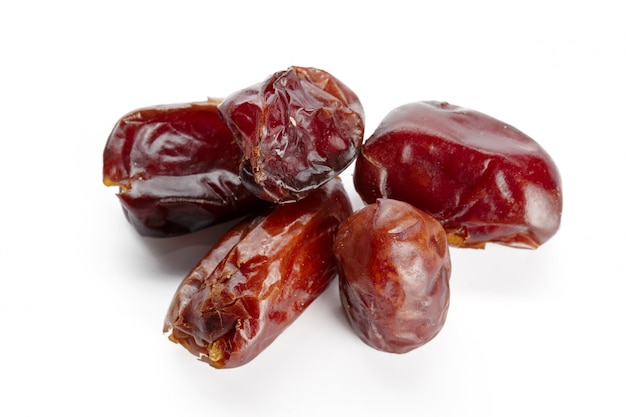
Dates count. The NHS says a 30g portion of dried fruit, and it names dates, counts as 1 of your 5 A Day. The catch is timing. Dried fruit should be eaten at mealtimes, not as a snack between meals, to reduce the impact on teeth. So the jar belongs next to the oats, not on the desk.
USDA FoodData Central (SR Legacy, 2019) gives Medjool dates 277 kcal and 6.7g of fibre per 100g (FDC 168191). Deglet Noor comes in at 282 kcal and 8.0g of fibre (FDC 171726). A 30g portion of Medjool is about 83 kcal with 2g of fibre; the same weight of Deglet Noor is about 85 kcal with 2.4g. That is a real contribution to the 30g fibre target, and also a reason to weigh the portion rather than eat from the bag.
Two easy uses: chop a few into porridge in the morning, or have a 30g portion on the side of a lentil curry at dinner. Both keep the dates at a meal, which is where the NHS wants them.
Moving more still matters
The NHS list also says to get active for 150 minutes a week, and that you can break this up into shorter sessions. It suggests swapping sugary drinks for water, with a slice of lemon or lime if you don't like the taste, and reading food labels, where more green colour coding than amber and red often means a healthier option. None of these come in a bottle either.
Buying dates in Malaysia
Every date sold in Malaysia is imported, because the country has no commercial date-growing trade. Medjool is the large, very soft variety with a rich caramel taste. Deglet Noor is the golden, semi-dry date from Tunisia and Algeria. For more suppliers to compare, Pembekal Kurma Selangor is another date supplier site.
The Dates Supplier about us page lists prices for retail and wholesale buyers and delivery across Malaysia. Send a WhatsApp message through the contact page for a quote, or read more on the Dates Supplier blog.
This article is general information about food and is not medical advice. If you want help with your weight, ask your GP.