
This article looks at one part of picking healthier food for the people you cook for: sugar. The NHS Healthier Families guide to sugar opens with a blunt figure. Kids are having over 2 times more sugar than is recommended, and half of it comes from snacks and sugary drinks.
So this article sticks to sugar. It covers how much the NHS says children should have, which sugars it asks families to cut, where dates sit in that picture, and a few habits for the supermarket trip. It ends with a simple side dish that puts dates on the dinner table instead of in the snack drawer.
The daily limit changes with age
The NHS gives a maximum recommended daily amount of sugar for each age band:
| Age | Maximum per day | Roughly |
|---|---|---|
| 4 to 6 years | 19 g | 5 sugar cubes |
| 7 to 10 years | 24 g | 6 sugar cubes |
| 11 years and older | 30 g | 7 sugar cubes |
Those numbers are small. The same page notes that a single chocolate bar can contain up to 24 grams of sugar, which is the entire day's allowance for a child aged 7 to 10.
Free sugars are the ones to cut
A separate NHS page on sugar gives the 19 g and 24 g figures for children aged 4 to 6 and 7 to 10 as limits on free sugars, and 30 g as the limit for adults. On the Healthier Families page, free sugars are sugars added to food and drink to sweeten it, whether by a manufacturer, a chef or you at home, plus the sugars released from the cell walls of fruit and vegetables when they are juiced, blended or puréed.
The foods it asks families to limit include honey, syrups (maple syrup among them), table sugar such as granulated, caster, icing or brown sugar, and fruit and vegetable juices, smoothies and purées. Homemade versions count too. On the other side, the page says you do not need to worry about the sugar in whole or chopped fruit, whole or chopped vegetables, plain milk and plain yoghurt.
Drinks get their own warning. The NHS says kids and adults should have no more than a combined 150ml of fruit juice and smoothies a day, kept to mealtimes. It also says 150ml of fruit juice can contain around 15g of sugar.
Where dates fit
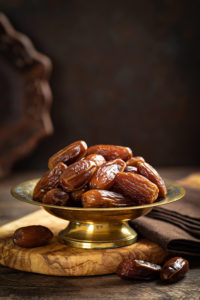
Dates appear by name on the NHS 5 A Day page, in its list of dried fruits: a 30g portion of dried fruit, such as currants, dates, sultanas and figs, counts as 1 of your 5 A Day. The same line adds a condition. Dried fruit should be eaten at mealtimes, not as a snack between meals, to reduce the impact on teeth.
The Healthier Families sugar page says the same thing in its own words: keep dried fruits to mealtimes and avoid eating them as a snack to protect your family's teeth. For a parent, the practical change is about timing. Chopped dates go with lunch or dinner. They don't go in a box to graze on after school.
If you want the bigger picture beyond sugar, this site's article on the WHO principles of a balanced diet covers the rest of the plate, and what meals have calcium works through a sample day.
Habits for the shopping trip
Several of the NHS tips happen before anything reaches the kitchen. Many products carry traffic light labels on the front of the pack, and the advice is to pick items with more greens and ambers and cut down on ones with any reds.
Big bottles of fizzy drinks and juice look like a good deal. The NHS point is that you're just getting more sugar, and it suggests water and plain lower-fat milks instead. Then there's the simplest trick on the page. If sugary sweets and treats are not in the house, nobody can eat them.
It also suggests getting children involved. Ask your kids to help prepare healthier snacks such as fruit or lower-sugar cereal, because they're more likely to eat what they've made. A low-fat plain yoghurt topped with chopped fruit or berries is one of its dessert ideas.
A side dish: grilled carrots and dates
Here is a way to serve dates as part of a meal. Grilled carrots and dates is a sweet and spicy side dish. It needs fresh ginger juice, which you can make by grating fresh ginger root and then pressing the pulp over a metal colander to collect the juice.
Ingredients: peeled carrots, olive oil, salt, black pepper, garam masala, cinnamon powder, chili powder, ginger juice and chopped dates.
Preheat the oven to 210°C (425°F). Put the carrots in a bowl with the olive oil, salt, pepper, spices and ginger juice, and stir until every carrot is coated. Spread them on an oven tray, set it in the middle of the oven and cook for 20 to 22 minutes, until completely soft. Mix in the dates and serve.
If a toddler is sharing the dish, the NHS guide to feeding young children says there's no need to add salt to a child's food, so keep a toddler's share of the carrots aside and leave the salt off it.
More about this site is on the About Us page and the contact page.